

Show Me the Money: 5 Steps How to Prove AI ROI and Justify Your Tech Investment (Easy Guide for SMBs)
You've heard the buzz about AI transforming businesses, but your CFO wants hard numbers. How do you prove that AI investment will actually pay off? For small and medium businesses, justifying tech spending isn't just about staying competitive: it's about survival.
The good news? 91% of SMBs using AI report revenue growth, and 75% see stronger revenue growth specifically. But here's the catch: you need a systematic approach to measure and prove that ROI before you can celebrate those wins.
Let's break down exactly how to build a bulletproof case for your AI investment.
Step 1: Document Your Starting Point
Before you can prove AI works, you need to know where you're starting. Think of this as taking a "before" photo for your business transformation.

Gather 30-60 days of baseline data across three critical areas:
Operational Metrics: How long does it take your team to complete key tasks? What's your current error rate? If you're looking at AI for customer support, track metrics like Average Handle Time (AHT) and First Response Time (FRT). For accounting processes, measure how many hours your team spends processing invoices or expense reports.
Customer Data: What are your current satisfaction scores? How's your customer retention? What's your average deal size? These metrics will help you measure AI's impact on customer experience later.
Financial Performance: Track revenue per employee, cost per transaction, or cost per customer resolution. These hard numbers will form the foundation of your ROI calculation.
Pro tip: Don't just grab averages from your software dashboard. Export actual performance reports: you'll need detailed data to make compelling comparisons later.
Step 2: Count Every Penny (Seriously)
Here's where most businesses mess up their ROI calculations: they forget about hidden costs. Your AI investment isn't just the software license: it's everything needed to make it work.
Direct Costs:
Software licenses and subscription fees
Cloud infrastructure upgrades
Integration costs to connect with existing systems
Hardware requirements (if any)
Hidden Costs:
Staff training and onboarding time
Temporary productivity dips during implementation
Compliance and security updates
Ongoing maintenance and support
Add a 20% contingency buffer to your total. Trust us on this: cloud prices change, compliance requirements evolve, and there's always something you didn't anticipate.

For example, if you're budgeting $10,000 for an AI customer service tool, plan for $12,000 to cover unexpected expenses.
Step 3: Identify What AI Will Actually Improve
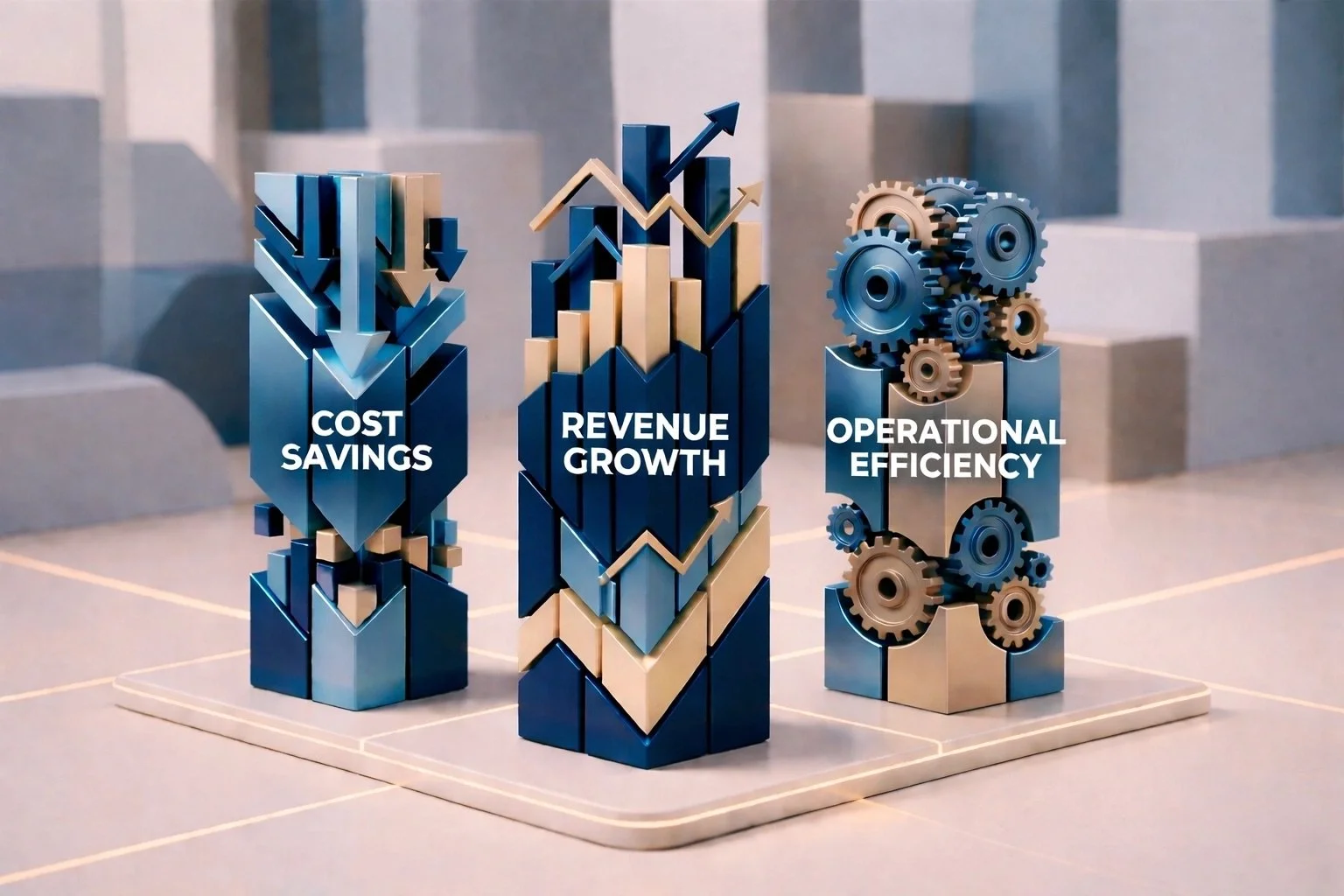
This is where the magic happens: but only if you're realistic about the benefits. Focus on three measurable areas:
Cost Savings (The Easy Win):
AI automation typically reduces time spent on routine workflows by 15-30%. But here's the key: only about 20% of time savings translate to actual financial savings unless you reduce staff or avoid future hiring.
Example: If AI saves your team 10 hours per week on data entry, that's only meaningful savings if you can reassign those people to revenue-generating activities or avoid hiring additional staff.
Revenue Growth (The Big Prize):
This is where AI can really shine. Look for improvements in:
Conversion rates from better lead scoring
Average deal sizes from personalized recommendations
Customer lifetime value from improved retention
Real example: A digital marketing agency achieved 500% ROI by automating email campaigns, saving £10,000 while generating £50,000 in new revenue.
Efficiency Gains (The Multiplier Effect):
Sometimes AI's biggest value isn't direct cost savings: it's enabling your team to do things they couldn't do before. Better analytics, faster decision-making, or improved customer insights can compound over time.
Step 4: Do the Math (It's Simpler Than You Think)
Now for the moment of truth. Use this straightforward formula:
ROI = (Net Benefits – Total Costs) / Total Costs × 100
Let's walk through a real example:
Total AI implementation costs: $9,500
Annual benefits: $20,000 (cost savings + revenue growth)
ROI = ($20,000 – $9,500) / $9,500 × 100 = 110.5% ROI
For most SMBs, targeting a 15-25% return is realistic, though benefits often take 2-4 years to fully materialize. However, some implementations show faster results: research shows SMBs can achieve positive ROI within 6 weeks, with 27% productivity increases and 23% cost reductions.
Set Realistic Expectations:
Months 1-6: Expect negative ROI due to upfront costs and learning curve
Months 6-12: Break-even or modest positive returns
Year 2+: Full benefits typically realized
Step 5: Track, Measure, and Adjust
Your work isn't done once AI is implemented. Set up regular check-ins at 30, 90, and 180 days to track actual performance against projections.

Use A/B Testing When Possible:
Have one team use the AI tool while another continues the old way. This isolates AI's actual impact from other business changes happening simultaneously.
Key Metrics to Monitor:
Are you hitting your cost reduction targets?
Is revenue growth materializing as expected?
What unexpected benefits or challenges have emerged?
Course Correction:
If ROI isn't meeting expectations, don't panic. Look for optimization opportunities:
Are users fully adopting the AI tools?
Do processes need refinement?
Are there additional use cases you haven't explored?
Making Your Case (The Bottom Line)
When presenting to leadership, lead with the numbers but tell the complete story. Your ROI calculation proves financial viability, but also highlight strategic benefits like competitive advantage, improved customer experience, and future scalability.
Remember: 75% of SMBs report stronger revenue growth after implementing AI. You're not taking a wild gamble: you're making a strategic investment with proven results across thousands of similar businesses.
Start Small, Think Big:
Begin with a pilot project in one area of your business. Prove ROI there, then expand to additional use cases. This approach reduces risk while building internal confidence in AI's value.
The companies winning with AI aren't necessarily the ones with the biggest budgets: they're the ones with the clearest measurement strategies and most realistic expectations. Follow these five steps, and you'll have the data you need to justify your investment and optimize for even better returns.
At Next Point Ventures, we've seen countless SMBs transform their operations through strategic AI adoption. The key isn't just implementing the technology; it's proving its value every step of the way.